脑电仿真中的噪声管理2.噪声仿真
Exploring emerging trends in brain-computer interface technology, from high-density EEG arrays to neural dust and the implications for human-computer interaction.
The Current Landscape
Brain-computer interfaces have come a long way since the first EEG recordings in the 1920s. Today, we're witnessing an unprecedented convergence of neuroscience, engineering, and artificial intelligence that's pushing the boundaries of what's possible.
Emerging Technologies
High-Density EEG Arrays
Traditional EEG caps use 32-256 electrodes. New dry electrode technologies are enabling systems with 1000+ channels while maintaining user comfort. This dramatic increase in spatial resolution could unlock new BCI paradigms.
Neural Dust
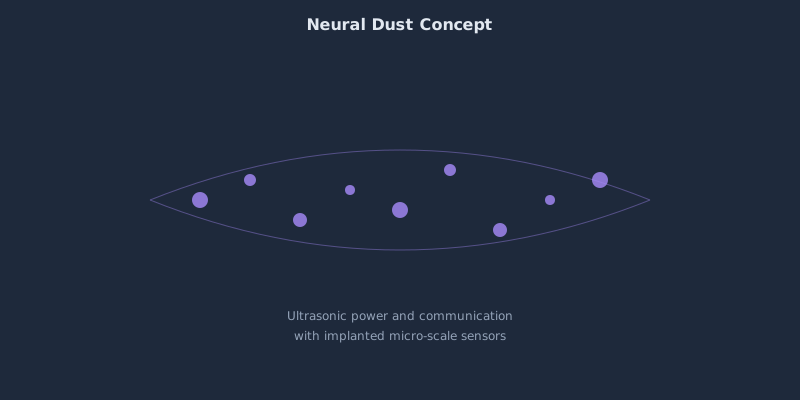
Researchers at UC Berkeley have proposed ultra-small wireless sensors (neural dust) that could be implanted in the cortex. These sensors, powered by ultrasound, could provide single-neuron resolution without the risks associated with traditional implanted electrodes.
Brain Organoid Interfaces
Perhaps the most fascinating development is the use of brain organoids (lab-grown mini-brains) as biological computing substrates. Early experiments have shown that these organoids can learn to play simple games, raising profound questions about the nature of intelligence.
Challenges Ahead
Technical Challenges
- Signal quality: Non-invasive methods still suffer from poor spatial resolution
- Long-term stability: Implanted electrodes degrade over time due to immune response
- Real-time processing: Decoding complex intentions requires significant computational power
Ethical Considerations
- Mental privacy: Should thoughts be protected as a fundamental right?
- Cognitive enhancement: Where do we draw the line between therapy and enhancement?
- Access and equity: Will neural interfaces widen or narrow the digital divide?
My Perspective
Having worked in BCI research for several years, I believe we're at an inflection point. The convergence of improved hardware, better algorithms (especially deep learning), and growing commercial interest suggests that practical, everyday BCIs are closer than most people think.
The key challenge isn't purely technical — it's creating interfaces that are reliable enough for daily use and accessible to everyone, not just researchers in well-equipped labs.
Looking Forward
The next decade will likely bring:
- Consumer-grade EEG devices with medical-grade signal quality
- Non-invasive BCIs capable of decoding speech intention
- Closed-loop neurostimulation systems for mental health treatment
- Brain-to-brain communication protocols
The future of neural interfaces is not just about reading the brain — it's about creating a new channel of communication between humans and machines that feels as natural as speaking or typing.